Background Guide
The purpose of this guide is to provide readers who are new to the subject with basic background information
surrounding the so-called Talpiot Tomb. This will include a brief review of the arguments for and against the
proposition that the Talpiot Tomb is the family tomb of Jesus of Nazareth (hereafter: the proposition). Readers
should consult the “Lines of Argument” section (click here) of this web-site if they want to develop a fuller
understanding of the arguments for or against the proposition. Readers desiring to read further should consult
the annotated Bibliography section (click here).
Background
Burial Practices in the time of Jesus
For a period of about one hundred years, generally ending around the time of the failed Jewish revolt in 70 CE,
many Jews of means were buried in ossuaries (i.e. bone boxes) inside rock-hewn, multi-generation family tombs.
It is thought that most Jews in the Jerusalem area could not afford this type of burial and thus often received
burial in shallow trench graves. About one-hundred of these rock-hewn tombs with ossuaries have been
uncovered and cataloged, in the area of Jerusalem. There are could be one-thousand additional uncataloged
or undiscovered rock-hewn tombs in this area. Estimates vary widely, due in part to lack of consensus as to how
many people could afford this type of burial.
Burial in rock-hewn tombs followed a typical pattern. The shrouded corpse was laid on a rock shelf within the
tomb for about one year. During this time the flesh would disintegrate, leaving just the bones. The bones were
then gathered and placed in a limestone bone-box called an ossuary (click here), that was stored within the
tomb.
These ossuaries were big enough to hold the longest bones in the body. Also it was common practice that an
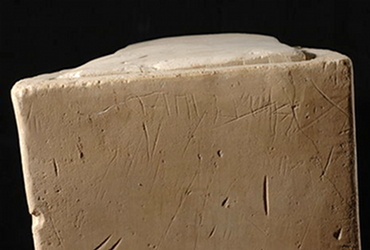
ossuary could contain the bones of multiple individuals. The “Jesus, son of Joseph” ossuary is typical in size at
about 1.7 cubic feet. About 25% of ossuaries carry an inscription which identified the occupant. In some cases,
this inscription would identify the father of the deceased or place of origin, while in some rare cases another
relative would be identified, such as a brother.
Entrances to tombs were blocked by a large blocking stone. The stone was moveable so that family members
could reenter the tomb in order to tend to the multigenerational burial needs of the family or in some cases the
extended family or clan.
As reported in the New Testament, when Joseph of Arimathea made arrangements for the burial of Jesus it
would seem that he was intent on undertaking the initial steps of the Jewish burial practice described above.
The Talpiot Tomb is Uncovered
In the spring of 1980 a construction crew working in the East Talpiot neighborhood of Jerusalem, uncovered a
tomb which is now commonly referred to as the “Talpiot Tomb” (hereafter the “tomb”). The tomb was reported to
the Israel Antiquities Authority (IAA) which undertook a “salvage” recovery operation under tight time
constraints. At the time of this initial operation the tomb was regarded as unremarkable by the IAA.
Following the recovery operation, the tomb was covered and remained so until it was reopened briefly in 2005.
The tomb was reopened in connection with a documentary film released in 2007 that was produced by Simcha
Jocobovici and titled “The Lost Tomb of Jesus”. At the completion of filming, the tomb was covered again, which
is how it remains today.
Ossuaries
The tomb contained 10 ossuaries, six of which contained identifying inscriptions. The official rendering by the
IAA of these six inscriptions is given below. The rendering of these inscriptions is critically important, because
supporters of the proposition see in these renderings several key names associated with the family of Jesus of
Nazareth. On the other hand, detractors point to possible incorrect readings or associations with New Testament
persons for some of these names.
It is important to note that reaching agreement on the rendering and interpretation of these inscriptions has been
complicated by the intertwining of the Aramaic and Hebrew languages. Furthermore, these names have come
down to us through history as translated into Greek and eventually into English. The problem of these readings
is given a more detailed treatment in the Line of Argument section titled: “Are some of the names wrong (click
here)
Talpiot Tomb Names
1. Mariamene e Mara (or Mariamene [also known as] Mara)
The rendering of this Greek inscription is hotly debated. For some, this is a name by which Mary Magdalene,
and very few others could be identified. Other renderings have been proposed, including the possibility that it is
actually two distinct names – Mariame and Mara.
2. Judah, son of Jesus/Yehuda bar Yeshua
This rendering is opposed by some because there is no reference to a son named Judah in the New Testament.
Others argue that there actually may be New Testament references to potential son. Still others argue that
failure to mention a son is reasonable, especially given the Roman practice of killing the sons of presumed
trouble makers.
3. Mathew/Matia
There is no known direct link to the name Mathew in the Jesus family tree. However, some supporters of the
proposition note that Mathew is a common name found in other families that are perhaps related to the family of
Jesus.
4. Jesus, son of Joseph/Yeshua bar Yosef
This inscription is difficult to read. As a result there has been some suggestion that the name could be
something other than Jesus. The official reading is reinforced given the presence of another “Yeshua”
reference in the tomb.
5. Joseph/Yoseh
“Yoseh” is a somewhat rare variant or nickname for Joseph; in English it would be something like Joey. For
some experts this is the name we should expect to see used to identify one of the brothers of Jesus, while others
suggest that this not correct. Also, it is noted by some that this could refer to the Joseph referenced on ossuary
#4.
6. Maria
For some this is the most likely form of the name Mary that could be ascribed to Mary, the mother of Jesus. This
is a latinized form of the name Mariam – as in the Latin “Ave Maria”. Others would suggest that it is just as likely
she would be identified by another form of the name Mariam.
The James Ossuary
The report from the initial recovery clearly shows that ten ossuaries were recovered and cataloged. However,
there are only nine Talpiot Tomb ossuaries to be found at the IAA storage facility. It is the position of the IAA
that the tenth ossuary was unremarkable and that it probably went into a general storage area and is no longer
locatable. Others who looked at the sequence of events see a possibility that the ossuary was stolen or lost,
perhaps during the recovery operation.
In 2002, an Israeli antiquities dealer brought forward an ossuary that bares the inscription “James son of Joseph
brother of Jesus”. Some experts accept that this inscription is legitimate and quite possibly associated with
James the eldest brother of Jesus. However, the IAA has taken the position that the inscription is at least partly a
forgery and therefore of no historical value.
Some supporters of the proposition suspect that this so-called “James Ossuary” could in fact be the missing
tenth ossuary described above. Another theory is that the James Ossuary could be an additional ossuary that
was stolen from the tomb before the IAA could assert control over the site and its ossuaries. Aside from the
remarkable name and the rough timing coincidence, the primary reason for suspecting that the James Ossuary
is from the Talpiot Tomb is that an elemental spectrum analysis of the patina from the James Ossuary matches
closely to the profile of elements found on other ossuaries from the Talpiot tomb. Also, if a Jesus family tomb
existed, it would not be surprising to find that it contained an ossuary for a brother named James.
This result is rejected by many experts who assert that the James Ossuary simply does not match the description
of the missing tenth ossuary as recorded in the IAA report on the Talpiot Tomb. They also point to suspicious
aspects of the inscription and the ossuary itself. As this guide is being written, the antiquities dealer who had
possession of the ossuary is being tried in Israel for forgery in connection with this matter. The outcome of this
trial is uncertain as problems have developed in the prosecutions case.
Other tomb observations
Supporters of the proposition note that there are several observations regarding the tomb that make it special
and that these special observations reinforce the likelihood that this is the family tomb of Jesus. Critics of this
argument see no particular significance in these observations. Three noteworthy examples are described below:
1. The tomb had been entered many centuries ago. It appears that whoever entered the tomb left behind
three skulls on the floor of the tomb that were arranged in pattern that suggested to some that the tomb held
special religious significance to the intruders.
2. The entrance to the tomb contains a symbol composed of a chevron over a circle (click here). Some
supporters of the proposition see this as an early Christian symbol. Other see the possibility that the Knights
Templar adopted this symbol as there own, demonstrating that they had secret knowledge that this was the tomb
of Jesus. Critics argue that similar motifs can be observed elsewhere without any association to Jesus,
Christianity or the Knights Templar.
3. A mark that some interpret as a cross can be found at the beginning (i.e. right) of the “Jesus son of
Joseph” inscription. Others see it as a flaw or a mason’s mark.
Summary Arguments for and against the proposition
Argument For the Proposition:
There is broad consensus that following his death on the cross Jesus was initially buried in a rock-hewn tomb at
the behest of Joseph of Arimathea. Furthermore there is substantial agreement that following the Sabbath this
tomb was found empty by Mary Magdalene and others.
Whoever took the body eventually would have reburied it according to prevailing Jewish burial practices and
that most likely would have meant burial in a rock-hewn tomb, of the Talpiot tomb type, in the area of
Jerusalem His family tomb would be located in Jerusalem because his family relocated there and his brother
James became a prominent leader of the Jesus movement in Jerusalem. Even if Jesus were poor, he clearly had
supporters who could have afforded to see to the cost of a rock-hewn tomb.
The primary reason for accepting the Talpiot Tomb as the family tomb of Jesus stems from the cluster of names
found on the ossuaries. This tomb contains the names of Jesus, Joseph (father?), Maria (mother?) and Yose
(brother?); all associated with the family of Jesus. A Mathew is present and his name is found commonly in the
Jesus family tree, albeit not in his direct family.
Judah also appears as the son of Jesus. This is significant because of the fact that Jesus had a brother named
Judah and it was common Jewish practice of naming children after significant relatives, such as brothers. There
is also a possibility that the brother named Judah is not actually a brother of Jesus, but rather is a son as
evidenced by this ossuary.
Furthermore, there is evidence that the tomb also contains a name strongly associated with Mary Magdalene.
DNA evidence shows that Jesus and this Mariamene are not maternally related, raising the possibility that she
was married to Jesus and the mother of Judah.
The strongest potential evidence of all is that the James Ossuary, with its inscription – James son of Joseph
brother of Jesus - may be a missing ossuary from the Talpiot Tomb.
Another reason to believe that the Talpiot Tomb is the family tomb of Jesus lies in the “special” nature of the
tomb as outlined above.
Argument Against the Proposition:
Supporters of the proposition have placed great weight on the cluster of names found in the tomb. However,
critics argue that they have made several errors in the process:
1. There is strong evidence that the James Ossuary is a forgery and that it is not the missing tenth ossuary.
2. The evidence that the Mariamene refers to Mary Magdalene is weak, stemming from a mis-application of
late, mostly irrelevant sources.
3. There is no historical support for the fact that Jesus could have been married and had a son named
Judah.
4. The Jesus son of Joseph ossuary is unreadable or has been misread; there may be no Jesus in the
tomb. Also, Jesus would not be identified as “son of Joseph”, but more likely would have been identified as
Jesus of Nazareth.
5. Maria is not the most likely name to associate with Mary the mother of Jesus.
6. Yoseh is not a likely name to be associated with one of the brothers of Jesus.
Additional arguments against the proposition are:
1. The tomb is not special. All of the “special” observations can be explained away without introducing the
family of Jesus.
2. Jesus was too poor to be buried in a rock-hewn tomb.
3. Jesus would have been buried in his home province of Galilee, not Jerusalem.
4. If Jesus had been buried in Jerusalem, surely the site would be renowned up to this day. Furthermore,
this knowledge would surely have impacted the direction of Christian teaching regarding the Resurrection.
5. Other tombs have been identified as potential burial locations for Jesus and/or his family.
Editorial Position
It is the editorial position of this site that neither of these arguments is conclusive. Further study and discovery
will be required before this debate can be resolved. Unfortunately, so much confusion and emotion already
exists surrounding the debate that it will be extremely difficult to move this discussion toward a clear conclusion.
JTERP will attempt to make a positive contribution to the process through education and research.
Reference Material
Readers looking for expanded material on this site can start by reviewing the “Lines of Argument” page (click
here) and then proceed to reading the individual Lines of Argument guides. If you are seeking additional
background see the Bibliography section. (click here).
In particular see references: 2, 3, 7, 31, 32, 34; with excellent supplementary background material at 5,9,15.
© Copyright 2009 JTERP All rights reserved